
Thu, Jul 23, 2026

Volume 20, Issue 2 (Mar-Apr 2026)
mljgoums 2026, 20(2): 42-46 |
Back to browse issues page



Download citation:
BibTeX | RIS | EndNote | Medlars | ProCite | Reference Manager | RefWorks
Send citation to:


BibTeX | RIS | EndNote | Medlars | ProCite | Reference Manager | RefWorks
Send citation to:
Bozorgi Mazandarani M, Kargar M, Kafilzadeh F. Prevalence of fluoroquinolone resistance genes in the Escherichia coli sequence type 131 clone isolated from hospitalized patients with urinary tract infection. mljgoums 2026; 20 (2) :42-46
URL: http://mlj.goums.ac.ir/article-1-1877-en.html
URL: http://mlj.goums.ac.ir/article-1-1877-en.html


1- Department of Microbiology, Ja.C., Islamic Azad University, Jahrom, Iran
2- Department of Microbiology, Zand Institute of Higher Education, Shiraz, Iran ,microkargar@gmail.com
2- Department of Microbiology, Zand Institute of Higher Education, Shiraz, Iran ,
Full-Text [PDF 478 kb]
(829 Downloads)
| Abstract (HTML) (3570 Views)
Full-Text: (65 Views)
Introduction
Fluoroquinolones (FQs), such as ciprofloxacin (CIP) and levofloxacin (LEV), are broad-spectrum antimicrobials used to treat a wide range of hospital- and community-acquired infections, such as urinary tract infections (UTIs) (1,2). The extensive use of antibiotics, particularly FQs, has inadvertently driven the selection and proliferation of multidrug-resistant (MDR) strains, such as Escherichia coli (E. coli) sequence type 131 (ST131). ST131, a pandemic clone linked to the spread of extended-spectrum beta-lactamases (ESBLs), has emerged as a global threat to public health (3). ST131 exhibits multidrug resistance to a broad spectrum of antibiotics, including aminoglycosides, cephalosporins, and FQs. ST131 is the most common MDR high-risk clone in UTIs worldwide. The emergence and spread of the MDR E. coli ST131 clone, particularly isolates resistant to FQs, are a major concern worldwide (4,5). Chromosomal mutations in the quinolone resistance-determining regions (QRDRs) of DNA gyrase and topoisomerase IV-enzymes necessary for bacterial DNA replication and repair-are key mechanisms of quinolone resistance, including resistance to nalidixic acid and reduced susceptibility to FQs. These mutations can enable bacteria to produce enzymes that destroy FQs or prevent them from entering bacterial cells (6,7). Plasmid-mediated quinolone resistance (PMQR) is another common mechanism contributing to quinolone and FQ resistance among gram-negative bacilli. Based on their mechanisms, PMQR determinants are categorized into three classes, including various qnr alleles, such as qnrA, qnrB, and qnrS; efflux pump genes, such as qepA and oqxAB; and a variant of aminoglycoside acetyltransferase, aac (6′)-Ib-cr (8-10). FQ-resistant bacteria can use efflux pumps to transport FQs out of their cells. The aim of this study was to detect the ST131 clone among FQ-resistant E. coli isolates from patients with UTIs. Additionally, mutations in the DNA gyrase and topoisomerase IV genes, as well as the presence of PMQR and efflux pump genes, were investigated using polymerase chain reaction (PCR) in FQ-resistant E. coli isolates.
Methods
Bacterial isolates
A total of 250 E. coli isolates were obtained from the urine of hospitalized patients with UTIs in hospital wards in Tehran, Iran, in 2020. Standard bacteriological methods were employed to identify these E. coli isolates (11). Before participation in the study, each patient or their parent/guardian provided written informed consent and received an explanation regarding the study purpose.
Susceptibility of the E. coli isolates to FQs
The Kirby-Bauer disk diffusion technique was employed to determine the susceptibility of the E. coli isolates to antibiotic disks (MAST, England), including nalidixic acid (NAL; 30 µg) and ciprofloxacin (CIP; 5 µg), according to the CLSI guidelines (12). Then, the minimum inhibitory concentration (MIC) of CIP was determined by E-test. The CLSI breakpoints for CIP were susceptible at ≤ 1 µg/mL and resistant at ≥ 4 µg/mL. E. coli ATCC 25922 and K. pneumoniae were used as quality control strains.
DNA extraction
Genomic DNA of E. coli isolates from pure cultures were extracted using the boiling method and stored at -20°C until use. The quality of the extracted DNA was confirmed by NanoDrop (Thermo Scientific, Roskilde, Denmark). An absorbance ratio at 260/280 nm above 1.7 indicated acceptable purity (13).
Screening of the ST131 clone
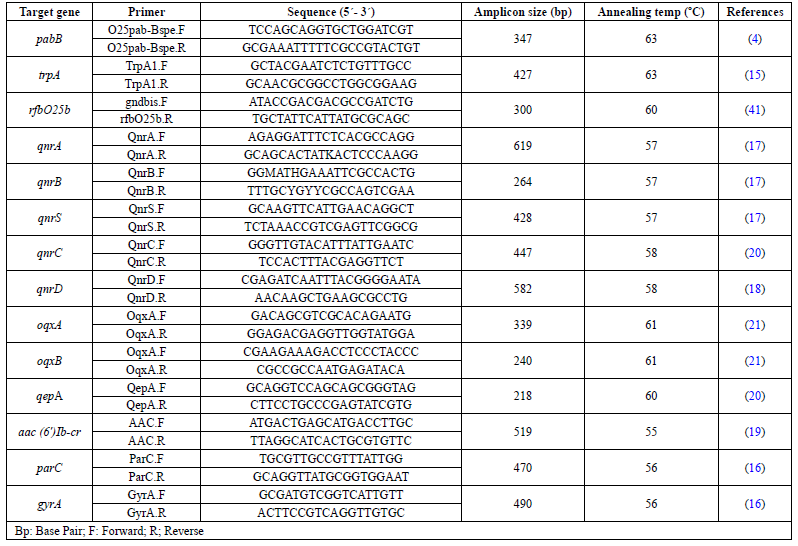
After DNA extraction from E. coli isolates, the ST131 clone was screened through ST131-specific sequence polymorphisms in mdh and gyrB (14). The O25b-ST131 variant was detected using allele-specific PCR targeting the pabB gene (4). The trpA gene was amplified as an internal control for the PCR reactions (15). The Multilocus Sequence Typing (MLST) system was employed to confirm the ST131 clone using seven housekeeping genes, including adk, fumC, gyrB, icd, mdh, purA, and recA (http://enterobase.warwick.ac.uk/species/ecoli/allele_st_search). Table 1 lists the sequences of the primers used in this study.
Table 1. Primers used to detect the ST131 clone and fluoroquinolone resistance genes
Detection of chromosomal mutations in the QRDRs
Mutations within the gyrA and parC genes of the FQ-resistant isolates were identified through amplification and sequencing of the QRDRs (16). First, the gyrA and parC genes were amplified by PCR using the primers listed in Table 1. Eventually, sequencing of the PCR products was performed with an ABI 3730XL DNA analyzer (Macrogen Inc., Korea). Nucleotide sequences were compared with reference sequences using the BLAST tools of the National Center for Biotechnology Information GenBank database (NCBI; http://www.ncbi.nlm.nih.gov/blast).http://www.ncbi.nlm.nih.gov/blast
Detection of the PMQR genes
Detection of the PMQR genes qnrA, qnrB, qnrS, qnrC, qnrD, and aac (6′)-Ib-cr was accomplished using previously described PCR methods (17-20).
Detection of the efflux pump genes
The efflux pump-encoding genes oqxA, oqxB, and qepA were detected by PCR using specific primers, as described previously (20,21).
In the PCR process, isolates with target genes confirmed by sequencing were used as positive controls, and isolates without the target gene were used as negative controls.
Statistical analysis
Statistical analysis of the data was carried out using R software version 3.3.3 and interpreted based on prevalence distribution and percentages. Data with a p-value less than or equal to 0.05 were regarded as statistically significant.
Results
Distribution of FQ resistance in the E. coli isolates
In this study, 200 E. coli isolates were obtained from patients aged 15 to 85 years. Female patients accounted for 57.8% (n = 115/200), compared with 42% (n = 85/200) among males. Of the 200 E. coli isolates, 47.5% (n = 95/200) were resistant to both NA and CIP, categorizing them as FQ-resistant. Approximately 75% (n = 71/95) of the E. coli isolates had CIP MIC ≥ 32 μg/mL, with 25% of isolates (n = 24/95) having MIC 4 - 6 μg/mL. Among the 95 FQ-resistant E. coli isolates, 30% (n = 29/95) were screened as the ST131 clone using PCR assay. All screened ST131 isolates belonged to the O25 serotype, also known as the O25-ST131 clone. High-level CIP resistance (MIC ≥ 32 mg/L) was found in 96.5% (n = 28/29) of ST131 and 65% (n = 43/66) of non-ST131 isolates (p = 0.001). The remaining 24 FQ-resistant isolates exhibited low-level CIP resistance (MIC 4 - 16 μg/mL).
Mutations in gyrA and parC
DNA sequence analysis of the QRDRs of gyrA and parC, shown in Table 2, revealed that the FQ-resistant E. coli isolates had two mutation types in gyrA and three in parC. Point mutations in gyrA occurred at positions 83 (Serine → Leucine) and 87 (Aspartic acid → Asparagine). In parC, mutations were found at positions 80 (Serine → Isoleucine), 84 (Glutamic acid → Valine), and 84 (Glutamic acid → Glycine). Single mutations S83L and D87N in gyrA were found in 20% (n = 19) and 11.5% (n = 11) of the FQ-resistant isolates, respectively. Single mutations identified in parC were S80I, E84V, and E84G, occurring in 10.5% (n = 10), 23% (n = 22), and 4% (n = 4) of the FQ-resistant isolates, respectively. Mutations in gyrA (Single or Double) within QRDRs were most frequently observed in 96% (n = 28/29) of ST131 and 82% (n = 54/66) of non-ST131 isolates (p = 0.05). Double amino acid substitutions in gyrA and parC were identified in 89% (n = 85/95) of FQ-resistant isolates; these substitutions were observed in 53.6% (n = 51/95) in the gyrA gene compared with 35.6% (n = 34/95) in the parC gene (p = 0.01). Comparative analysis revealed a significant difference in the presence of double mutations, S80I + E84V in gyrA (76% ST131 vs. 43% non-ST131; p = 0.004) and S80I + E84V in parC (55% ST131 vs. 26% non-ST131; p = 0.002). Isolates with double mutations exhibited significantly higher levels of CIP resistance (p ≤ 0.05). Among the FQ-resistant isolates, six non-ST131 isolates had a wild-type QRDR, while the remaining isolates (n = 89/95, 93.6%) had amino acid exchanges in one or both gyrA or parC genes.
Prevalence of PMQR resistance genes and the aac (6′)-Ib-cr variant
Table 2 shows the prevalence of FQ resistance genes in FQ-resistant E. coli isolates; 74.7% (n = 71/95) of isolates possessed at least one PMQR gene. The most common PMQR gene was qnrS, which was found in 42% (n = 40/95) of E. coli isolates, followed by aac (6′)-Ib-cr (n = 35/95; 36%), qnrB (n = 15/95; 16%), qnrC (n = 5/95; 5.2%), and qnrD (n= 1/95; 1%). The qnrA gene was not found in any of the FQ-resistant E. coli isolates. The aac (6′)-Ib-cr and qnrS genes were the most frequently observed PMQR genes in ST131 (n = 16/29, 55%) and non-ST131 isolates (n = 28/66, 42%). Statistical analysis indicated a significant relationship between the presence of aac (6′)-Ib-cr and the ST131 clone compared with non-ST131 (p < 0.03).
Twelve ST131 isolates carried more than one PMQR gene in the following combinations: qnrS + qnrB (n = 2), qnrS + qnrD (n = 1), qnrS + aac (6′)-Ib-cr (n = 5), qnrS + qnrB + aac (6′)-Ib-cr (n = 2), and qnrS + qnrC + aac (6′)-Ib-cr (n = 2). In contrast, the combinations of PMQR genes in 18 non-ST131 isolates were as follows: qnrS + qnrB (n = 7), qnrB + aac (6′)-Ib-cr (n = 2), qnrS + aac (6′)-Ib-cr (n = 4), qnrB + aac (6′)-Ib-cr (n = 3), qnrS + qnrB + aac (6′)-Ib-cr (n = 1), and qnrS + qnrC + aac (6′)-Ib-cr (n = 1).
Prevalence of efflux pump genes
In FQ-resistant E. coli isolates, 37% (n = 35/95) were positive for at least one of the three efflux pump genes: qepA (n = 11/95, 11.5%), oqxA (n = 27/95, 28%), and oqxB (n = 13/95, 13.5%). Notably, oqxA had the highest prevalence in both ST131 (n = 11/29; 38%) and non-ST131 (n=16/66; 24%) isolates.
Table 2. Prevalence of the FQ resistance genes in the FQ-resistant E. coli isolates

n: Number; FQ-R: Fluoroquinolone Resistance; QRDR: Quinolone Resistance-Determining Regions; PMQR: Plasmid-Mediated Quinolone Resistance.
*A p-value less than or equal to 0.05 is typically considered to be statistically significant.
Discussion
FQs are a class of antibiotics commonly used to treat UTIs. The rise and distribution of FQ-resistant E. coli strains-especially the ST131 clone-represent a major public health concern because of their strong capacity for widespread international dissemination (22,23). This study screened the prevalence of E. coli ST131 and FQ resistance genes in patients with UTIs.
Identifying how common these resistance determinants are and how they are distributed is essential for selecting suitable antibiotics and strengthening infection control strategies. In the current study, the FQ resistance rate in E. coli isolates exceeded 47.5%. Damavandi et al. observed 48% FQ resistance in E. coli isolates obtained from inpatients, which is very close to the present research (24). The prevalence of FQ resistance varies across different countries, with rates reported as 20 - 30% in Turkey, 62.25% in China, 51.8% in Pakistan, and 55.6% in Iran (25-28). Variations in reported FQ resistance rates among E. coli isolates can be attributed to factors such as local antibiotic-prescribing habits, infection control quality, and circulation of high-risk lineages such as ST131 (29). Our study found that the ST131 clone accounted for 30% (n = 29/95) of FQ-resistant isolates, regardless of whether the isolates produced extended-spectrum beta-lactamases (ESBLs). Raoulinasab et al. reported that among FQ-resistant isolates producing ESBLs, 55% (n = 30/60) belonged to the ST131 clone (30).
FQ antibiotics exert their bactericidal effects by inhibiting DNA gyrase and topoisomerase IV, enzymes essential for bacterial DNA replication. However, the primary target of these antibiotics can vary depending on the bacterial species and the type of FQ used (31,32). This study demonstrated a significantly higher prevalence of mutations in the gyrA gene compared with the parC gene. Moreover, double mutations within gyrA (53.6%) were also significantly more frequent than double mutations in parC (35.6%; p = 0.01). Research evaluating E. coli isolates carrying mutations in both enzymes indicates that DNA gyrase is typically the main target of fluoroquinolones and is more readily inhibited by these drugs. Topoisomerase IV appears to play a secondary role. Consequently, mutations in the gyrA gene, which codes for the gyrase A subunit, often confer initial resistance to FQs. In contrast, mutations in parC, encoding topoisomerase IV subunits, typically arise later during the development of multidrug resistance (33). There are few reports evaluating FQ resistance genes in the ST131 clone (30,34,35). The current study showed a significantly higher frequency of double mutations in gyrA (S83L and D87N) and parC (S80I and E84V) among ST131 isolates compared with non-ST131 isolates. In a study conducted in Iran, a significant frequency (80%) of double mutations in parC was observed in ST131 isolates (30). The emergence of double mutations in the ST131 clone highlights the urgent need for comprehensive strategies to prevent the spread of these extensively drug-resistant strains, including rigorous surveillance, infection control protocols, and antibiotic stewardship programs. The substitution E84G in parC was not observed in any ST131 isolates, consistent with the findings of previous studies (30,34). Chromosomal mutations lead to alterations in topoisomerase enzymes, rendering them less susceptible to the inhibitory effects of ciprofloxacin. In the present study, E-test MIC experiments revealed high-level ciprofloxacin resistance (MIC ≥ 32 μg/mL) in 96.6% (28/29) of ST131 isolates compared with 65% (43/66) of non-ST131 isolates, and this difference was statistically significant (p = 0.001). The higher frequency of double mutations in the gyrA and parC genes within ST131 isolates may explain this disparity. Consistent with our findings, a previous study from Iran reported that all ST131 isolates exhibited MIC ≥ 32 μg/mL to ciprofloxacin (30). Interestingly, six non-ST131 bacteria with wild-type QRDR had low levels of ciprofloxacin resistance in our study.
PMQR genes are another FQ resistance mechanism. Among the FQ-resistant E. coli isolates, 74.7% harbored at least one PMQR gene, qnr or aac (6′)-Ib-cr. The qnrS gene emerged as the most prevalent in 63% of FQ-resistant isolates. The aac (6′)-Ib-cr and qnrS genes were the most frequently occurring PMQR genes in ST131 (n = 16, 55%) and non-ST131 isolates (n = 28, 42%). Statistical analysis indicated a significant relationship between the presence of aac (6′)-Ib-cr and the ST131 clone (62%; p < 0.03). In a study in Mexico, similar to our study, 100% (n = 14/14) of O25-ST131 lineage isolates had aac (6′)-Ib-cr, and 7% (n = 1/14) had qnrA1 (35). The significant association (p < 0.03) of the aac (6′)-Ib-cr gene with the ST131 lineage in this study suggests a potential role for this gene in FQ resistance. Further research is needed to elucidate the specific contribution of aac (6′)-Ib-cr to fluoroquinolone resistance in ST131. The aac (6′)-Ib-cr enzyme, as a bifunctional acetyltransferase, can modify aminoglycosides and quinolones simultaneously, conferring resistance to clinically relevant aminoglycosides (36,37).
In these multidrug-resistant (MDR) bacteria, efflux pumps work overtime to push antibiotics out of the cell, lowering the concentration of the drug inside and making the bacteria less susceptible (38). The spread of efflux pump genes such as oqxAB among bacteria raises serious concerns for public health (39). Our results showed that 37% of FQ-resistant isolates were positive for at least one oqxA, oqxB, or qepA gene, with oqxA being the most prevalent efflux pump gene (28%). ST131 isolates exhibited a higher prevalence of oqxA and oqxB genes compared with non-ST131 isolates; however, this difference was not statistically significant (p > 0.05). In another study in Iran, the most common FQ resistance efflux pump genes were oqxB (34%), followed by oqxA (25%) and qnrB (18%) (40). The results highlight the need for continuous monitoring of quinolone resistance determinants to minimize the emergence and selection of high-risk E. coli clones showing reduced susceptibility or resistance to quinolones.
The limitation of our study is that further surveys should include different resistance genes and more isolates using different laboratory methods.
Conclusion
This study revealed a worrying prevalence of FQ-resistant E. coli, particularly within the ST131 clone, highlighting the need for continuous monitoring to inform infection control strategies and minimize the spread of these resistant strains. The high frequency of mutations in gyrA and the presence of PMQR genes such as aac (6′)-Ib-cr were alarming indicators of FQ resistance. In addition, the significant association between double mutations and the aac (6′)-Ib-cr gene with the ST131 lineage warrants further investigation in resistance development.
Acknowledgement
The equipment support provided for this study by the Islamic Azad University of Jahrom is acknowledged.
Funding Sources
This research received no external funding.
Ethical Statement
This study was approved by the Islamic Azad University, Jahrom Branch, Iran (NO. p-162376730).
Conflicts of Interest
The authors declare they have no conflicts of interest.
Author Contributions
Mehdi Bozorgi Mazandarani, Mohammad Kargar, and Farshid Kafilzadeh supervised the study, collected samples, performed the work, and wrote and edited the manuscript.
Data Availability Statement
No new data were created or analyzed in this study. Data sharing does not apply to this article.
Use of Artificial Intelligence
The authors confirm that no artificial intelligence tools were used, either directly or indirectly, in the preparation of this article.
Fluoroquinolones (FQs), such as ciprofloxacin (CIP) and levofloxacin (LEV), are broad-spectrum antimicrobials used to treat a wide range of hospital- and community-acquired infections, such as urinary tract infections (UTIs) (1,2). The extensive use of antibiotics, particularly FQs, has inadvertently driven the selection and proliferation of multidrug-resistant (MDR) strains, such as Escherichia coli (E. coli) sequence type 131 (ST131). ST131, a pandemic clone linked to the spread of extended-spectrum beta-lactamases (ESBLs), has emerged as a global threat to public health (3). ST131 exhibits multidrug resistance to a broad spectrum of antibiotics, including aminoglycosides, cephalosporins, and FQs. ST131 is the most common MDR high-risk clone in UTIs worldwide. The emergence and spread of the MDR E. coli ST131 clone, particularly isolates resistant to FQs, are a major concern worldwide (4,5). Chromosomal mutations in the quinolone resistance-determining regions (QRDRs) of DNA gyrase and topoisomerase IV-enzymes necessary for bacterial DNA replication and repair-are key mechanisms of quinolone resistance, including resistance to nalidixic acid and reduced susceptibility to FQs. These mutations can enable bacteria to produce enzymes that destroy FQs or prevent them from entering bacterial cells (6,7). Plasmid-mediated quinolone resistance (PMQR) is another common mechanism contributing to quinolone and FQ resistance among gram-negative bacilli. Based on their mechanisms, PMQR determinants are categorized into three classes, including various qnr alleles, such as qnrA, qnrB, and qnrS; efflux pump genes, such as qepA and oqxAB; and a variant of aminoglycoside acetyltransferase, aac (6′)-Ib-cr (8-10). FQ-resistant bacteria can use efflux pumps to transport FQs out of their cells. The aim of this study was to detect the ST131 clone among FQ-resistant E. coli isolates from patients with UTIs. Additionally, mutations in the DNA gyrase and topoisomerase IV genes, as well as the presence of PMQR and efflux pump genes, were investigated using polymerase chain reaction (PCR) in FQ-resistant E. coli isolates.
Methods
Bacterial isolates
A total of 250 E. coli isolates were obtained from the urine of hospitalized patients with UTIs in hospital wards in Tehran, Iran, in 2020. Standard bacteriological methods were employed to identify these E. coli isolates (11). Before participation in the study, each patient or their parent/guardian provided written informed consent and received an explanation regarding the study purpose.
Susceptibility of the E. coli isolates to FQs
The Kirby-Bauer disk diffusion technique was employed to determine the susceptibility of the E. coli isolates to antibiotic disks (MAST, England), including nalidixic acid (NAL; 30 µg) and ciprofloxacin (CIP; 5 µg), according to the CLSI guidelines (12). Then, the minimum inhibitory concentration (MIC) of CIP was determined by E-test. The CLSI breakpoints for CIP were susceptible at ≤ 1 µg/mL and resistant at ≥ 4 µg/mL. E. coli ATCC 25922 and K. pneumoniae were used as quality control strains.
DNA extraction
Genomic DNA of E. coli isolates from pure cultures were extracted using the boiling method and stored at -20°C until use. The quality of the extracted DNA was confirmed by NanoDrop (Thermo Scientific, Roskilde, Denmark). An absorbance ratio at 260/280 nm above 1.7 indicated acceptable purity (13).
Screening of the ST131 clone
After DNA extraction from E. coli isolates, the ST131 clone was screened through ST131-specific sequence polymorphisms in mdh and gyrB (14). The O25b-ST131 variant was detected using allele-specific PCR targeting the pabB gene (4). The trpA gene was amplified as an internal control for the PCR reactions (15). The Multilocus Sequence Typing (MLST) system was employed to confirm the ST131 clone using seven housekeeping genes, including adk, fumC, gyrB, icd, mdh, purA, and recA (http://enterobase.warwick.ac.uk/species/ecoli/allele_st_search). Table 1 lists the sequences of the primers used in this study.
Table 1. Primers used to detect the ST131 clone and fluoroquinolone resistance genes
Detection of chromosomal mutations in the QRDRs
Mutations within the gyrA and parC genes of the FQ-resistant isolates were identified through amplification and sequencing of the QRDRs (16). First, the gyrA and parC genes were amplified by PCR using the primers listed in Table 1. Eventually, sequencing of the PCR products was performed with an ABI 3730XL DNA analyzer (Macrogen Inc., Korea). Nucleotide sequences were compared with reference sequences using the BLAST tools of the National Center for Biotechnology Information GenBank database (NCBI; http://www.ncbi.nlm.nih.gov/blast).http://www.ncbi.nlm.nih.gov/blast
Detection of the PMQR genes
Detection of the PMQR genes qnrA, qnrB, qnrS, qnrC, qnrD, and aac (6′)-Ib-cr was accomplished using previously described PCR methods (17-20).
Detection of the efflux pump genes
The efflux pump-encoding genes oqxA, oqxB, and qepA were detected by PCR using specific primers, as described previously (20,21).
In the PCR process, isolates with target genes confirmed by sequencing were used as positive controls, and isolates without the target gene were used as negative controls.
Statistical analysis
Statistical analysis of the data was carried out using R software version 3.3.3 and interpreted based on prevalence distribution and percentages. Data with a p-value less than or equal to 0.05 were regarded as statistically significant.
Results
Distribution of FQ resistance in the E. coli isolates
In this study, 200 E. coli isolates were obtained from patients aged 15 to 85 years. Female patients accounted for 57.8% (n = 115/200), compared with 42% (n = 85/200) among males. Of the 200 E. coli isolates, 47.5% (n = 95/200) were resistant to both NA and CIP, categorizing them as FQ-resistant. Approximately 75% (n = 71/95) of the E. coli isolates had CIP MIC ≥ 32 μg/mL, with 25% of isolates (n = 24/95) having MIC 4 - 6 μg/mL. Among the 95 FQ-resistant E. coli isolates, 30% (n = 29/95) were screened as the ST131 clone using PCR assay. All screened ST131 isolates belonged to the O25 serotype, also known as the O25-ST131 clone. High-level CIP resistance (MIC ≥ 32 mg/L) was found in 96.5% (n = 28/29) of ST131 and 65% (n = 43/66) of non-ST131 isolates (p = 0.001). The remaining 24 FQ-resistant isolates exhibited low-level CIP resistance (MIC 4 - 16 μg/mL).
Mutations in gyrA and parC
DNA sequence analysis of the QRDRs of gyrA and parC, shown in Table 2, revealed that the FQ-resistant E. coli isolates had two mutation types in gyrA and three in parC. Point mutations in gyrA occurred at positions 83 (Serine → Leucine) and 87 (Aspartic acid → Asparagine). In parC, mutations were found at positions 80 (Serine → Isoleucine), 84 (Glutamic acid → Valine), and 84 (Glutamic acid → Glycine). Single mutations S83L and D87N in gyrA were found in 20% (n = 19) and 11.5% (n = 11) of the FQ-resistant isolates, respectively. Single mutations identified in parC were S80I, E84V, and E84G, occurring in 10.5% (n = 10), 23% (n = 22), and 4% (n = 4) of the FQ-resistant isolates, respectively. Mutations in gyrA (Single or Double) within QRDRs were most frequently observed in 96% (n = 28/29) of ST131 and 82% (n = 54/66) of non-ST131 isolates (p = 0.05). Double amino acid substitutions in gyrA and parC were identified in 89% (n = 85/95) of FQ-resistant isolates; these substitutions were observed in 53.6% (n = 51/95) in the gyrA gene compared with 35.6% (n = 34/95) in the parC gene (p = 0.01). Comparative analysis revealed a significant difference in the presence of double mutations, S80I + E84V in gyrA (76% ST131 vs. 43% non-ST131; p = 0.004) and S80I + E84V in parC (55% ST131 vs. 26% non-ST131; p = 0.002). Isolates with double mutations exhibited significantly higher levels of CIP resistance (p ≤ 0.05). Among the FQ-resistant isolates, six non-ST131 isolates had a wild-type QRDR, while the remaining isolates (n = 89/95, 93.6%) had amino acid exchanges in one or both gyrA or parC genes.
Prevalence of PMQR resistance genes and the aac (6′)-Ib-cr variant
Table 2 shows the prevalence of FQ resistance genes in FQ-resistant E. coli isolates; 74.7% (n = 71/95) of isolates possessed at least one PMQR gene. The most common PMQR gene was qnrS, which was found in 42% (n = 40/95) of E. coli isolates, followed by aac (6′)-Ib-cr (n = 35/95; 36%), qnrB (n = 15/95; 16%), qnrC (n = 5/95; 5.2%), and qnrD (n= 1/95; 1%). The qnrA gene was not found in any of the FQ-resistant E. coli isolates. The aac (6′)-Ib-cr and qnrS genes were the most frequently observed PMQR genes in ST131 (n = 16/29, 55%) and non-ST131 isolates (n = 28/66, 42%). Statistical analysis indicated a significant relationship between the presence of aac (6′)-Ib-cr and the ST131 clone compared with non-ST131 (p < 0.03).
Twelve ST131 isolates carried more than one PMQR gene in the following combinations: qnrS + qnrB (n = 2), qnrS + qnrD (n = 1), qnrS + aac (6′)-Ib-cr (n = 5), qnrS + qnrB + aac (6′)-Ib-cr (n = 2), and qnrS + qnrC + aac (6′)-Ib-cr (n = 2). In contrast, the combinations of PMQR genes in 18 non-ST131 isolates were as follows: qnrS + qnrB (n = 7), qnrB + aac (6′)-Ib-cr (n = 2), qnrS + aac (6′)-Ib-cr (n = 4), qnrB + aac (6′)-Ib-cr (n = 3), qnrS + qnrB + aac (6′)-Ib-cr (n = 1), and qnrS + qnrC + aac (6′)-Ib-cr (n = 1).
Prevalence of efflux pump genes
In FQ-resistant E. coli isolates, 37% (n = 35/95) were positive for at least one of the three efflux pump genes: qepA (n = 11/95, 11.5%), oqxA (n = 27/95, 28%), and oqxB (n = 13/95, 13.5%). Notably, oqxA had the highest prevalence in both ST131 (n = 11/29; 38%) and non-ST131 (n=16/66; 24%) isolates.
Table 2. Prevalence of the FQ resistance genes in the FQ-resistant E. coli isolates
n: Number; FQ-R: Fluoroquinolone Resistance; QRDR: Quinolone Resistance-Determining Regions; PMQR: Plasmid-Mediated Quinolone Resistance.
*A p-value less than or equal to 0.05 is typically considered to be statistically significant.
Discussion
FQs are a class of antibiotics commonly used to treat UTIs. The rise and distribution of FQ-resistant E. coli strains-especially the ST131 clone-represent a major public health concern because of their strong capacity for widespread international dissemination (22,23). This study screened the prevalence of E. coli ST131 and FQ resistance genes in patients with UTIs.
Identifying how common these resistance determinants are and how they are distributed is essential for selecting suitable antibiotics and strengthening infection control strategies. In the current study, the FQ resistance rate in E. coli isolates exceeded 47.5%. Damavandi et al. observed 48% FQ resistance in E. coli isolates obtained from inpatients, which is very close to the present research (24). The prevalence of FQ resistance varies across different countries, with rates reported as 20 - 30% in Turkey, 62.25% in China, 51.8% in Pakistan, and 55.6% in Iran (25-28). Variations in reported FQ resistance rates among E. coli isolates can be attributed to factors such as local antibiotic-prescribing habits, infection control quality, and circulation of high-risk lineages such as ST131 (29). Our study found that the ST131 clone accounted for 30% (n = 29/95) of FQ-resistant isolates, regardless of whether the isolates produced extended-spectrum beta-lactamases (ESBLs). Raoulinasab et al. reported that among FQ-resistant isolates producing ESBLs, 55% (n = 30/60) belonged to the ST131 clone (30).
FQ antibiotics exert their bactericidal effects by inhibiting DNA gyrase and topoisomerase IV, enzymes essential for bacterial DNA replication. However, the primary target of these antibiotics can vary depending on the bacterial species and the type of FQ used (31,32). This study demonstrated a significantly higher prevalence of mutations in the gyrA gene compared with the parC gene. Moreover, double mutations within gyrA (53.6%) were also significantly more frequent than double mutations in parC (35.6%; p = 0.01). Research evaluating E. coli isolates carrying mutations in both enzymes indicates that DNA gyrase is typically the main target of fluoroquinolones and is more readily inhibited by these drugs. Topoisomerase IV appears to play a secondary role. Consequently, mutations in the gyrA gene, which codes for the gyrase A subunit, often confer initial resistance to FQs. In contrast, mutations in parC, encoding topoisomerase IV subunits, typically arise later during the development of multidrug resistance (33). There are few reports evaluating FQ resistance genes in the ST131 clone (30,34,35). The current study showed a significantly higher frequency of double mutations in gyrA (S83L and D87N) and parC (S80I and E84V) among ST131 isolates compared with non-ST131 isolates. In a study conducted in Iran, a significant frequency (80%) of double mutations in parC was observed in ST131 isolates (30). The emergence of double mutations in the ST131 clone highlights the urgent need for comprehensive strategies to prevent the spread of these extensively drug-resistant strains, including rigorous surveillance, infection control protocols, and antibiotic stewardship programs. The substitution E84G in parC was not observed in any ST131 isolates, consistent with the findings of previous studies (30,34). Chromosomal mutations lead to alterations in topoisomerase enzymes, rendering them less susceptible to the inhibitory effects of ciprofloxacin. In the present study, E-test MIC experiments revealed high-level ciprofloxacin resistance (MIC ≥ 32 μg/mL) in 96.6% (28/29) of ST131 isolates compared with 65% (43/66) of non-ST131 isolates, and this difference was statistically significant (p = 0.001). The higher frequency of double mutations in the gyrA and parC genes within ST131 isolates may explain this disparity. Consistent with our findings, a previous study from Iran reported that all ST131 isolates exhibited MIC ≥ 32 μg/mL to ciprofloxacin (30). Interestingly, six non-ST131 bacteria with wild-type QRDR had low levels of ciprofloxacin resistance in our study.
PMQR genes are another FQ resistance mechanism. Among the FQ-resistant E. coli isolates, 74.7% harbored at least one PMQR gene, qnr or aac (6′)-Ib-cr. The qnrS gene emerged as the most prevalent in 63% of FQ-resistant isolates. The aac (6′)-Ib-cr and qnrS genes were the most frequently occurring PMQR genes in ST131 (n = 16, 55%) and non-ST131 isolates (n = 28, 42%). Statistical analysis indicated a significant relationship between the presence of aac (6′)-Ib-cr and the ST131 clone (62%; p < 0.03). In a study in Mexico, similar to our study, 100% (n = 14/14) of O25-ST131 lineage isolates had aac (6′)-Ib-cr, and 7% (n = 1/14) had qnrA1 (35). The significant association (p < 0.03) of the aac (6′)-Ib-cr gene with the ST131 lineage in this study suggests a potential role for this gene in FQ resistance. Further research is needed to elucidate the specific contribution of aac (6′)-Ib-cr to fluoroquinolone resistance in ST131. The aac (6′)-Ib-cr enzyme, as a bifunctional acetyltransferase, can modify aminoglycosides and quinolones simultaneously, conferring resistance to clinically relevant aminoglycosides (36,37).
In these multidrug-resistant (MDR) bacteria, efflux pumps work overtime to push antibiotics out of the cell, lowering the concentration of the drug inside and making the bacteria less susceptible (38). The spread of efflux pump genes such as oqxAB among bacteria raises serious concerns for public health (39). Our results showed that 37% of FQ-resistant isolates were positive for at least one oqxA, oqxB, or qepA gene, with oqxA being the most prevalent efflux pump gene (28%). ST131 isolates exhibited a higher prevalence of oqxA and oqxB genes compared with non-ST131 isolates; however, this difference was not statistically significant (p > 0.05). In another study in Iran, the most common FQ resistance efflux pump genes were oqxB (34%), followed by oqxA (25%) and qnrB (18%) (40). The results highlight the need for continuous monitoring of quinolone resistance determinants to minimize the emergence and selection of high-risk E. coli clones showing reduced susceptibility or resistance to quinolones.
The limitation of our study is that further surveys should include different resistance genes and more isolates using different laboratory methods.
Conclusion
This study revealed a worrying prevalence of FQ-resistant E. coli, particularly within the ST131 clone, highlighting the need for continuous monitoring to inform infection control strategies and minimize the spread of these resistant strains. The high frequency of mutations in gyrA and the presence of PMQR genes such as aac (6′)-Ib-cr were alarming indicators of FQ resistance. In addition, the significant association between double mutations and the aac (6′)-Ib-cr gene with the ST131 lineage warrants further investigation in resistance development.
Acknowledgement
The equipment support provided for this study by the Islamic Azad University of Jahrom is acknowledged.
Funding Sources
This research received no external funding.
Ethical Statement
This study was approved by the Islamic Azad University, Jahrom Branch, Iran (NO. p-162376730).
Conflicts of Interest
The authors declare they have no conflicts of interest.
Author Contributions
Mehdi Bozorgi Mazandarani, Mohammad Kargar, and Farshid Kafilzadeh supervised the study, collected samples, performed the work, and wrote and edited the manuscript.
Data Availability Statement
No new data were created or analyzed in this study. Data sharing does not apply to this article.
Use of Artificial Intelligence
The authors confirm that no artificial intelligence tools were used, either directly or indirectly, in the preparation of this article.
Research Article: Original Paper |
Subject:
bacteriology
Received: 2024/11/1 | Accepted: 2025/03/15 | Published: 2026/04/29 | ePublished: 2026/04/29
Received: 2024/11/1 | Accepted: 2025/03/15 | Published: 2026/04/29 | ePublished: 2026/04/29
References
1. Kim Y, Kim B, Wie SH, Kim J, Ki M, Cho YK, et al. Fluoroquinolone can be an effective treatment option for acute pyelonephritis when the minimum inhibitory concentration of levofloxacin for the causative Escherichia coli is ≤ 16 mg/L. Antibiotics. 2021;10(1):37. [View at Publisher] [DOI] [PMID] [Google Scholar]
2. Wagenlehner FM, Wagenlehner C, Redman R, Weidner W, Naber KG. Urinary bactericidal activity of doripenem versus that of levofloxacin in patients with complicated urinary tract infections or pyelonephritis. Antimicrob Agents Chemother. 2009;53(4):1567-73. [View at Publisher] [DOI] [PMID] [Google Scholar]
3. Nicolas-Chanoine M-H, Blanco J, Leflon-Guibout V, Demarty R, Alonso MP, Caniça MM, et al. Intercontinental emergence of Escherichia coli clone O25: H4-ST131 producing CTX-M-15. J Antimicrob Chemother. 2008;61(2):273-81. [View at Publisher] [DOI] [PMID] [Google Scholar]
4. Clermont O, Dhanji H, Upton M, Gibreel T, Fox A, Boyd D, et al. Rapid detection of the O25b-ST131 clone of Escherichia coli encompassing the CTX-M-15-producing strains. J Antimicrob Chemother. 2009;64(2):274-7. [View at Publisher] [DOI] [PMID] [Google Scholar]
5. Ismail MD, Ali I, Hatt S, Salzman EA, Cronenwett AW, Marrs CF, et al. Association of Escherichia coli ST131 lineage with risk of urinary tract infection recurrence among young women. J Glob Antimicrob Resist. 2018;13:81-4. [View at Publisher] [DOI] [PMID] [Google Scholar]
6. Minarini LA, Darini ALC. Mutations in the quinolone resistance-determining regions of gyrA and parC in Enterobacteriaceae isolates from Brazil. Braz J Microbiol. 2012;43:1309-14. [View at Publisher] [DOI] [PMID] [Google Scholar]
7. Ruiz J. Mechanisms of resistance to quinolones: target alterations, decreased accumulation and DNA gyrase protection. J Antimicrob Chemother. 2003;51(5):1109-17. [View at Publisher] [DOI] [PMID] [Google Scholar]
8. Hooper DC, Jacoby GA. Mechanisms of drug resistance: quinolone resistance. Ann N Y Acad Sci. 2015;1354(1):12-31. [View at Publisher] [DOI] [PMID] [Google Scholar]
9. Azargun R, Gholizadeh P, Sadeghi V, Hosainzadegan H, Tarhriz V, Memar MY, et al. Molecular mechanisms associated with quinolone resistance in Enterobacteriaceae: review and update. Trans R Soc Trop Med Hyg. 2020;114(10):770-81. [View at Publisher] [DOI] [PMID] [Google Scholar]
10. Yamane K, Wachino J-i, Suzuki S, Arakawa Y. Plasmid-mediated qepA gene among Escherichia coli clinical isolates from Japan. Antimicrob Agents Chemother. 2008;52(4):1564-6. [View at Publisher] [DOI] [PMID] [Google Scholar]
11. Zhou J, Zhou J, Chen M, Lü P, Jiang C. Prevalence of β-lactam antibiotic resistance of Escherichia coli isolated from a neonatal intensive care unit. BMC Pediatr. 2025;25(1):95. [View at Publisher] [DOI] [PMID] [Google Scholar]
12. Wayne P. Clinical and Laboratory Standards Institute: Annapolis Junction. MD, USA. 2025. [View at Publisher]
13. Hammond DS, Schooneveldt JM, Nimmo GR, Huygens F, Giffard PM. bla SHV genes in Klebsiella pneumoniae: different allele distributions are associated with different promoters within individual isolates. Antimicrob Agents Chemother. 2005;49(1):256-63. [View at Publisher] [DOI] [PMID] [Google Scholar]
14. Johnson JR, Clermont O, Johnston B, Clabots C, Tchesnokova V, Sokurenko E, et al. Rapid and specific detection, molecular epidemiology, and experimental virulence of the O16 subgroup within Escherichia coli sequence type 131. J Clin Microbiol. 2014;52(5):1358-65. [View at Publisher] [DOI] [PMID] [Google Scholar]
15. Clermont O, Lavollay M, Vimont S, Deschamps C, Forestier C, Branger C, et al. The CTX-M-15-producing Escherichia coli diffusing clone belongs to a highly virulent B2 phylogenetic subgroup.J Antimicrob Chemother. 2008;61(5):1024-8. [View at Publisher] [DOI] [PMID] [Google Scholar]
16. Zhao L, Zhang J, Zheng B, Wei Z, Shen P, Li S, et al. Molecular epidemiology and genetic diversity of fluoroquinolone-resistant Escherichia coli isolates from patients with community-onset infections in 30 Chinese county hospitals. J Clin Microbiol. 2015;53(3):766-70. [View at Publisher] [DOI] [PMID] [Google Scholar]
17. Cattoir V, Poirel L, Rotimi V, Soussy C-J, Nordmann P. Multiplex PCR for detection of plasmid-mediated quinolone resistance qnr genes in ESBL-producing enterobacterial isolates. J Antimicrob Chemother. 2007;60(2):394-7. [View at Publisher] [DOI] [PMID] [Google Scholar]
18. Cavaco LM, Hasman H, Xia S, Aarestrup FM. qnrD, a novel gene conferring transferable quinolone resistance in Salmonella enterica serovar Kentucky and Bovismorbificans strains of human origin. Antimicrob Agents Chemother. 2009;53(2):603-8. [View at Publisher] [DOI] [PMID] [Google Scholar]
19. Platell JL, Cobbold RN, Johnson JR, Heisig A, Heisig P, Clabots C, et al. Commonality among fluoroquinolone-resistant sequence type ST131 extraintestinal Escherichia coli isolates from humans and companion animals in Australia. Antimicrob Agents Chemother. 2011;55(8):3782-7. [View at Publisher] [DOI] [PMID] [Google Scholar]
20. Wang M, Guo Q, Xu X, Wang X, Ye X, Wu S, et al. New plasmid-mediated quinolone resistance gene, qnrC, found in a clinical isolate of Proteus mirabilis. Antimicrob Agents Chemother. 2009;53(5):1892-7. [View at Publisher] [DOI] [PMID] [Google Scholar]
21. Chen X, Zhang W, Pan W, Yin J, Pan Z, Gao S, et al. Prevalence of qnr, aac (6′)-Ib-cr, qepA, and oqxAB in Escherichia coli isolates from humans, animals, and the environment. Antimicrob Agents Chemother. 2012;56(6):3423-7. [View at Publisher] [DOI] [PMID] [Google Scholar]
22. Dalhoff A. Global fluoroquinolone resistance epidemiology and implictions for clinical use. Interdiscip Perspect Infect Dis. 2012:2012:976273. [View at Publisher] [DOI] [PMID] [Google Scholar]
23. Nicolas-Chanoine M-H, Bertrand X, Madec J-Y. Escherichia coli ST131, an intriguing clonal group. Clin Microbiol Rev. 2014;27(3):543-74. [View at Publisher] [DOI] [PMID] [Google Scholar]
24. Damavandi M-S, Gholipour A, Pour ML. Prevalence of class D carbapenemases among extended-spectrum β-lactamases producing Escherichia coli isolates from educational hospitals in Shahrekord. J Clin Diagn Res. 2016;10(5):DC01-5. [View at Publisher] [DOI] [PMID] [Google Scholar]
25. Afsharikhah S, Ghanbarpour R, Mohseni P, Adib N, Bagheri M, Jajarmi M. High prevalence of β-lactam and fluoroquinolone resistance in various phylotypes of Escherichia coli isolates from urinary tract infections in Jiroft city, Iran. BMC Microbiol. 2023;23(1):114. [View at Publisher] [DOI] [PMID] [Google Scholar]
26. Akgoz M, Akman I, Ates AB, Celik C, Keskin B, Ozmen Capin BB, et al. Plasmidic fluoroquinolone resistance genes in fluoroquinolone-resistant and/or extended spectrum Beta-Lactamase-Producing Escherichia coli Strains Isolated from Pediatric and adult patients diagnosed with urinary tract infection. Microb Drug Resist. 2020;26(11):1334-41. [View at Publisher] [DOI] [PMID] [Google Scholar]
27. Bullens M, de Cerqueira Melo A, Raziq S, Lee J, Khalid G, Khan S, et al. Antibiotic resistance in patients with urinary tract infections in Pakistan. Public Health Action. 2022;12(1):48-52. [View at Publisher] [DOI] [PMID] [Google Scholar]
28. Zeng Q, Xiao S, Gu F, He W, Xie Q, Yu F, et al. Antimicrobial resistance and molecular epidemiology of uropathogenic Escherichia coli isolated from female patients in Shanghai, China. Front Cell Infect Microbiol. 2021;11:653983. [View at Publisher] [DOI] [PMID] [Google Scholar]
29. McDermott E. The threat of antibiotic resistance on global health. 2019. [View at Publisher] [Google Scholar]
30. Rasoulinasab M, Shahcheraghi F, Feizabadi MM, Nikmanesh B, Hajihasani A, Aslani MM. Distribution of ciprofloxacin-resistance genes among ST131 and non-ST131 clones of Escherichia coli isolates with ESBL phenotypes isolated from women with urinary tract infection. Iran J Microbiol 2021;13(3):294. [View at Publisher] [DOI] [PMID] [Google Scholar]
31. Hiasa H. DNA topoisomerases as targets for antibacterial agents. Methods Mol Biol. 2018:47-62. [View at Publisher] [DOI] [PMID] [Google Scholar]
32. Spencer AC, Panda SS. DNA Gyrase as a Target for Quinolones. Biomedicines. 2023;11(2):371. [View at Publisher] [DOI] [PMID] [Google Scholar]
33. Heisig P. Genetic evidence for a role of parC mutations in development of high-level fluoroquinolone resistance in Escherichia coli. Antimicrob Agents Chemother. 1996;40(4):879-85. [View at Publisher] [DOI] [PMID] [Google Scholar]
34. Hajihasani A, Ebrahimi-Rad M, Rasoulinasab M, Aslani MM, Shahcheraghi F. The Molecular Characterization and Risk Factors of ST131 and Non-ST131 Escherichia coli in Healthy Fecal Carriers in Tehran, Iran. Jundishapur J Microbiol. 2022;15(5);e122468. [View at Publisher] [DOI] [Google Scholar]
35. Reyna-Flores F, Barrios H, Garza-Ramos U, Sánchez-Pérez A, Rojas-Moreno T, Uribe-Salas FJ, et al. Molecular epidemiology of Escherichia coli O25b-ST131 isolates causing community-acquired UTIs in Mexico. Diagn Microbiol Infect Dis. 2013;76(3):396-8. [View at Publisher] [DOI] [PMID] [Google Scholar]
36. Bush NG, Diez-Santos I, Sankara Krishna P, Clavijo B, Maxwell A. Insights into antibiotic resistance promoted by quinolone exposure. Antimicrob Agents Chemother. 2025;69(1):e0099724. [View at Publisher] [DOI] [PMID] [Google Scholar]
37. Serwacki P, Hareza D, Gajda M, Świątek-Kwapniewska W, Adamowska M, Serwacka K, et al. Fluoroquinolone consumption and resistance after an Antibiotic Stewardship Team intervention-an interventional study in a single hospital in southern Poland from 2018-2023. Am J Infect Control. 2025;53(5):612-8. [View at Publisher] [DOI] [PMID] [Google Scholar]
38. Nikaido H, Pagès J-M. Broad-specificity efflux pumps and their role in multidrug resistance of Gram-negative bacteria. FEMS Microbiol Rev. 2012;36(2):340-63. [View at Publisher] [DOI] [PMID] [Google Scholar]
39. Li J, Zhang H, Ning J, Sajid A, Cheng G, Yuan Z, et al. The nature and epidemiology of OqxAB, a multidrug efflux pump. Antimicrob Resist Infect Control. 2019;8:1-13. [View at Publisher] [DOI] [PMID] [Google Scholar]
40. Ghotaslou R, Baghbani S, Ghotaslou P, Mirmahdavi S, Leylabadlo HE. Molecular epidemiology of antibiotic-resistant Escherichia coli among clinical samples isolated in Azerbaijan, Iran. Iran J Microbiol. 2023;15(3):383-91. [View at Publisher] [DOI] [PMID] [Google Scholar]
41. Johnson JR, Menard M, Johnston B, Kuskowski MA, Nichol K, Zhanel GG. Epidemic clonal groups of Escherichia coli as a cause of antimicrobial-resistant urinary tract infections in Canada, 2002 to 2004. Antimicrob Agents Chemother. 2009;53(7):2733-9. [View at Publisher] [DOI] [PMID] [Google Scholar]
Send email to the article author
| Rights and permissions | |
 |
This work is licensed under a Creative Commons Attribution-NonCommercial 4.0 International License. |

This work is licensed under a Creative Commons Attribution-NonCommercial 4.0 International License.

Contact us
Tel & Fax: (+98) 17-32450093
E-mail:
 goums.ac.ir
 yahoo.com